
With Malaysia’s hot and humid weather, air conditioning can run for hours every day.
That makes electricity consumption an important consideration when choosing a new aircond.
For many homeowners and businesses, the question is no longer simply:
“Which aircond is cheapest to buy?”
A better question is:
“Which aircond will cost less to operate over the years I use it?”
This is one reason inverter aircond installation has become increasingly popular in Malaysian homes, apartments, offices and commercial spaces.
Inverter technology can help reduce unnecessary electricity consumption by allowing the compressor to adjust its operating speed instead of repeatedly running at full power and switching off.
But installing an inverter aircond does not automatically guarantee a low electricity bill.
The aircond still needs to be correctly sized, properly installed and used sensibly.
Here is what you should know before choosing an energy-efficient aircond installation in Malaysia.
What Is an Inverter Aircond?
The main difference between inverter and traditional non-inverter air conditioners is how the compressor operates.
A conventional non-inverter aircond generally operates its compressor at a fixed speed.
Once the room reaches the selected temperature, the compressor switches off. When the room warms again, it starts again.
An inverter air conditioner works differently.
Instead of constantly switching between full operation and stopping, the inverter system can adjust the compressor speed according to the cooling demand.
Panasonic Malaysia explains that once a room has cooled, an inverter aircond can reduce compressor motor speed to maintain the required temperature while reducing unnecessary energy consumption.
Think of it like driving a car.
A non-inverter system behaves more like repeatedly accelerating hard and braking.
An inverter system can reduce speed and cruise once the required temperature has been reached.
Are Inverter Aircons Worth It in Malaysia?
For many Malaysian households that use air conditioning for several hours each day, an inverter model can be worth considering.
The biggest potential advantage appears when the aircond operates long enough to reach the desired temperature and then maintain it efficiently.
Common examples include:
- Bedrooms where the aircond runs throughout the night
- Living rooms used for several hours
- Home offices
- Offices operating throughout the working day
- Clinics and retail premises
- Frequently occupied commercial spaces
Manufacturers such as Panasonic report lower energy consumption for inverter systems compared with comparable non-inverter models because the compressor can vary its speed instead of repeatedly cycling on and off. Actual savings, however, vary according to the model, temperature setting, room conditions and usage pattern.
This last point is important.
An inverter aircond is not a guarantee of a specific percentage saving for every Malaysian home.
Your results depend heavily on how the aircond is selected and used.
Start With the Energy-Efficiency Rating
Before comparing features such as Wi-Fi control, air purification or smart sensors, check the energy-efficiency label.
Malaysia regulates air conditioners as energy-using products under the Energy Efficiency and Conservation Act framework.
From 1 January 2026, the Energy Commission introduced an updated air-conditioner star-rating schedule that will apply through 31 December 2029, with stricter efficiency criteria intended to reflect improvements in current technology.
When comparing two airconds of similar capacity, the energy-efficiency rating can therefore provide useful information about their relative efficiency.
Do not compare the star rating without also checking that both airconds provide the cooling capacity your room actually requires.
Energy-Saving Tip #1: Choose the Correct Aircond Capacity
One of the biggest mistakes when planning inverter aircond installation is choosing the wrong horsepower.
A unit that is too small may have to work continuously trying to cool the room.
A unit that is unnecessarily large may cost more to purchase and may not provide the best operating characteristics for the space.
Aircond sizing should consider more than floor area.
Important factors include:
- Room size
- Ceiling height
- Number of occupants
- Amount of direct sunlight
- Window size
- Room orientation
- Computers and appliances
- Roof exposure
- Insulation
- Typical operating hours
Even aircond manufacturers include heat from sunlight, lighting, computers, appliances and occupants when discussing room cooling requirements.
For this reason, avoid choosing horsepower based only on what your neighbour installed.
Your room may have a completely different cooling load.
Energy-Saving Tip #2: Don’t Buy Based on Price Alone
An inexpensive aircond may save money on the day you purchase it.
But the purchase price is only one part of the total cost.
Think about:
Purchase price + installation + electricity consumption + servicing + repairs + expected lifespan
If an aircond is used frequently for several years, operating cost becomes increasingly important.
This is where a more efficient inverter model may justify a higher upfront price.
For a guest room used only occasionally, however, the financial advantage may take longer to recover.
The correct decision therefore depends on your usage pattern.
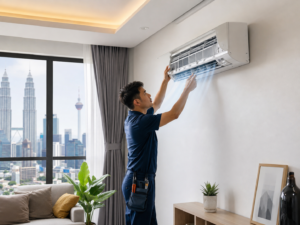
Energy-Saving Tip #3: Installation Quality Matters
Buying an efficient aircond but installing it poorly defeats the purpose.
A professional energy-efficient aircond installation should consider:
- Correct indoor-unit positioning
- Suitable outdoor-unit ventilation
- Proper refrigerant piping
- Correct pipe insulation
- Appropriate drainage
- Electrical requirements
- Secure connections
- Proper system testing
The outdoor compressor also needs enough space to release heat effectively.
Placing it in a badly ventilated or excessively confined area can make heat rejection more difficult.
Your installer should therefore assess both the indoor and outdoor locations rather than simply choosing the easiest mounting position.
Energy-Saving Tip #4: Keep Copper Piping Properly Insulated
The refrigerant lines connecting the indoor and outdoor units should be properly installed and insulated.
Poor or damaged insulation can reduce system efficiency and contribute to condensation problems.
Ask your installer what type of insulation is included and whether additional piping will be required.
This is particularly important in condominiums and properties where the outdoor unit must be installed a considerable distance from the indoor unit.
Energy-Saving Tip #5: Don’t Set the Temperature Unnecessarily Low
Many people switch on the aircond and immediately select the lowest available temperature.
That does not necessarily mean the room will become comfortable instantly.
A more sensible approach is to select a comfortable temperature and allow the system to maintain it.
One advantage of inverter technology is its ability to reduce compressor speed after reaching the required room temperature rather than constantly operating at maximum output.
The exact setting that feels comfortable will vary by person, room and humidity level.
The goal should be comfortable cooling rather than making the room unnecessarily cold.
Energy-Saving Tip #6: Keep Doors and Windows Closed
Even an efficient inverter aircond will waste energy if cooled air continually escapes.
Check:
- Windows
- Balcony doors
- Main doors
- Large gaps around openings
- Frequently opened doors in commercial premises
If hot outdoor air continuously enters the room, the aircond needs to keep removing that additional heat.
Improving the room itself can sometimes be just as important as purchasing a more efficient air conditioner.
Energy-Saving Tip #7: Reduce Heat Entering the Room
Air-conditioning demand increases when the room absorbs large amounts of heat.
Simple measures may help, such as:
- Closing curtains during strong afternoon sunlight
- Using blinds
- Using appropriate window treatments
- Reducing unnecessary lighting
- Switching off unused heat-producing equipment
A west-facing room with large glass windows may require substantially more cooling than a shaded room of the same floor area.
This is another reason aircond sizing should be based on the actual space.
Energy-Saving Tip #8: Clean and Service the Aircond
Airflow is an important part of cooling performance.
Dust accumulation on filters and internal components can affect airflow and system performance.
Homeowners should clean accessible filters according to the manufacturer’s recommendations and arrange professional servicing when required.
Commercial properties operating airconds for long hours may need a more structured maintenance schedule.
Energy-efficient equipment works best when it is maintained properly.
Inverter vs Non-Inverter Aircond: Which Should You Choose?
Here is a simple way to think about the decision.
| Situation | Inverter May Be Better | Non-Inverter May Still Be Considered |
| Aircond used every night | ✓ | |
| Aircond runs many hours daily | ✓ | |
| Office use | ✓ | |
| Electricity efficiency is priority | ✓ | |
| More stable temperature desired | ✓ | |
| Very occasional guest-room use | ✓ | |
| Lowest upfront cost is main priority | ✓ | |
| Short-term or temporary property use | Depends | ✓ |
This is a general decision framework rather than a universal rule.
Model efficiency should still be compared individually.
Don’t Assume Every Inverter Aircond Is Equally Efficient
“Inverter” describes how the compressor is controlled.
It does not mean every inverter model has identical efficiency.
Two inverter airconds with the same horsepower can still have different energy-performance ratings.
This is why buyers should compare:
- Cooling capacity
- Energy-efficiency/star rating
- Annual energy-consumption information where provided
- Warranty
- Installation requirements
- After-sales support
- Purchase price
Malaysia’s Energy Commission requires regulated energy-using products, including air conditioners, to comply with energy-efficiency requirements before being distributed in the local market.
Questions to Ask Before Installing an Inverter Aircond
Before confirming your installation, ask:
- What HP or cooling capacity does my room require?
- Why are you recommending this capacity?
- What is the model’s energy-efficiency rating?
- How much copper piping is included?
- Is the piping properly insulated?
- Is electrical work included?
- Where will the outdoor compressor be installed?
- Is the location adequately ventilated?
- What installation testing is included?
- Is there a workmanship warranty?
- What maintenance schedule is recommended?
- Are there additional installation charges?
These questions can help you evaluate the entire installation rather than simply comparing aircond prices.
So, Is an Inverter Aircond Worth It in Malaysia?
For households and businesses that operate air conditioning for several hours every day, an inverter aircond can be a sensible long-term choice.
The technology allows the compressor to adjust its speed according to cooling demand, which can reduce unnecessary energy consumption and help maintain a more consistent room temperature compared with traditional fixed-speed operation.
However, the word “inverter” alone should not determine your purchase.
The best results come from combining:
An efficient aircond + correct sizing + proper installation + sensible temperature settings + regular maintenance.
That combination matters far more than selecting an inverter unit simply because the label says “energy saving.”
Need Inverter Aircond Installation in Kuala Lumpur?
If you are replacing an old aircond or installing a new system, it is worth assessing the room before choosing the unit.
The correct capacity and installation arrangement can help you get better performance from the system you purchase.
For professional inverter aircond installation in KL, visit our [Aircond Installation page] to request an assessment and quotation.
SEO Metadata
SEO Title: Inverter Aircond Installation Malaysia: Energy-Saving Guide
Meta Description: Is an inverter aircond worth it in Malaysia? Learn how inverter aircond installation, correct sizing, energy ratings and smart usage can help reduce electricity consumption.
Suggested URL Slug:
/inverter-aircond-installation-malaysia/
Primary Keyword:
inverter aircond installation
Secondary Keyword:
energy-efficient aircond installation
Supporting Keywords:
inverter aircond installation KL
inverter air conditioner Malaysia
energy-saving aircond Malaysia
energy-efficient aircond KL
inverter vs non-inverter aircond
aircond electricity saving Malaysia
Long-Tail / LLM Questions Covered:
- Are inverter aircons worth it in Malaysia?
- Does inverter aircond save electricity?
- Is inverter better than non-inverter aircond?
- How do I choose an energy-efficient aircond in Malaysia?
- Does aircond installation affect energy consumption?
- What should I check before installing an inverter aircond?
- Is a 5-star aircond better for electricity savings?
Target Location:
Malaysia & Kuala Lumpur
Suggested Internal Link:
Aircond Installation page
Recommended Word Count:
1,000–1,300 word